

Albertine Book Club Spring 2026
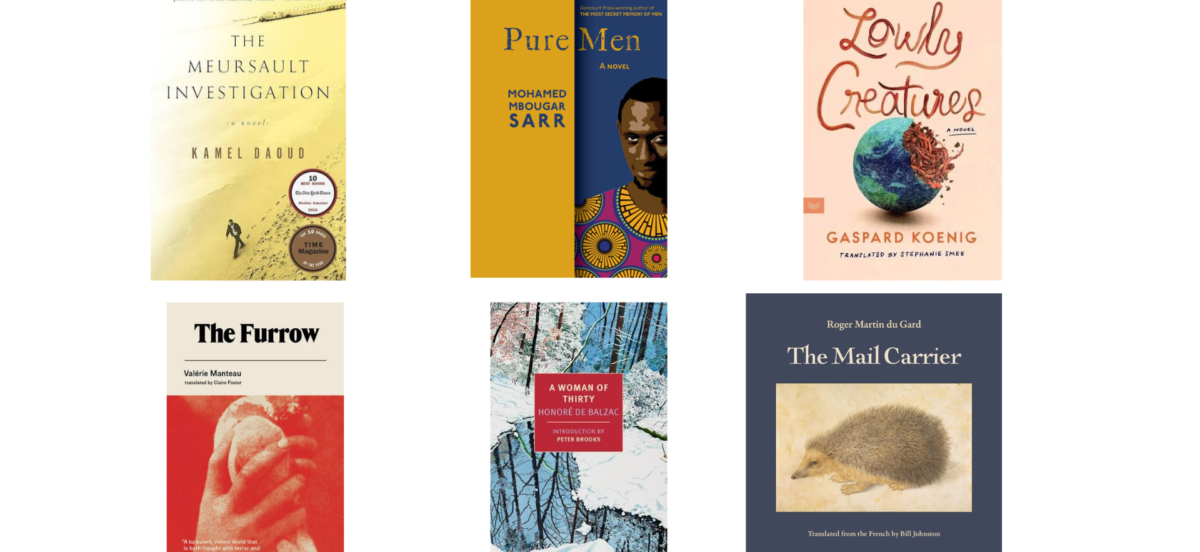
This spring, our book club reads will take us from a beach in Algeria to a graveyard in Dakar, to an ecoterrorist collective in Normandy, to the heart of Istanbul, to Napoleonic Paris, and to dawn in a French village.
These books invites you on a journey through space and time, exploring the complex histories, resonances, and voices that link classic and contemporary literature. Each month, take a break from your routine and connect with fellow readers from across the United States. The Albertine Book Club offers a welcoming space for conversation, discovery, and community among Francophiles.
Moderated by the Albertine team, the Book Club is open to all Albertine Constellation members. To learn more about Albertine membership, click here.
Read more about the upcoming selections below.
January: The Meursault Investigation/Meursault contre enquête by Kamel Daoud, translated from the French by John Cullen (Other Press).
He was the brother of “the Arab” killed by the infamous Meursault, the antihero of Camus’s classic novel. Seventy years after that event, Harun, who has lived since childhood in the shadow of his sibling’s memory, refuses to let him remain anonymous: he gives his brother a story and a name—Musa—and describes the events that led to Musa’s casual murder on a dazzlingly sunny beach. In a bar in Oran, night after night, he ruminates on his solitude, on his broken heart, on his anger with men desperate for a god, and on his disarray when faced with a country that has so disappointed him. A stranger among his own people, he wants to be granted, finally, the right to die.
The Stranger is of course central to Daoud’s story, in which he both endorses and criticizes one of the most famous novels in the world. A worthy complement to its great predecessor, The Meursault Investigation is not only a profound meditation on Arab identity and the disastrous effects of colonialism in Algeria, but also a stunning work of literature in its own right, told in a unique and affecting voice.
February: Pure Men/De purs hommes by Mohamed Mbougar Sarr, translated from the French by Lara Vargnaud (Other Press).
A viral video makes the rounds in Dakar, showing an incensed crowd that gathers to dig up a grave and drag the corpse from holy ground. When Ndéné, a French literature teacher, watches it, he’s surprisingly affected. Who was this man, and what could he have done to deserve such a fate? The answer soon becomes clear: he was a “góor-jigéen,” one of the so-called “men-women,” the shameful label given to homosexuals, cross-dressers, or any man who lives outside the accepted norm.
Haunted by the video, Ndéné sets out to learn more. With the help of a friend who works in night life, he explores a hidden side of Dakar, away from the rigid Islam of his family and university. Although he feels a certain disgust for homosexuality, he’s moved by the suffering and resilience of the people he meets. But the further he goes, the more he doubts his own identity, threatening to become an object of suspicion and scorn himself.
March: Lowly Creatures by Gaspard Koenig, translated from the French by Stephanie Smee (Harper Via).
Lowly Creatures follows the twin destinies of two young men, Kevin and Arthur, each of whom has vowed to dedicate his life to earthworms to save the earth from impending ecological disaster. Their shared passion brings them together at a Paris agri-tech school, then drives them apart as they pursue divergent paths.
Arthur, an anxious, idealistic, man raised in a bourgeois family, moves to rural Normandy with his girlfriend to attempt a Thoreau-like experiment of introducing earthworms to the soil of his grandfather’s abandoned farm. Kevin, the handsome, free-spirited, pansexual son of farmers from the French countryside, partners with an ambitious business school classmate to create a worm-composting startup. Arthur thinks Kevin has sold out, while Kevin is frustrated by the hopelessness of Arthur’s plan.
April: The Furrow by Valérie Manteau, translated from the French by Claire Foster (Invisible Books).
First published in France to major acclaim, The Furrow follows a French writer living with her lover in an Istanbul caught in the turmoil of Erdoğan’s rule. As the city around her strains under the weight of disorder and conflict, she discovers the story of Hrant Dink, the Turkish-Armenian journalist whose life and assassination become a catalyzing force for Turkish resistance writ large and for the narrator’s own writerly ambition. Manteau’s singular rhythm and sinuous prose deliver a novel that stretches the seams of historical memory and personal narrative. As the narrator’s voice disintegrates into the tangled language of her community, Manteau asks us to question who is telling what story and why. At once a feminist reading and fervent defence of democracy, Manteau’s second novel—and first work to appear in English—galvanizes the reader to inhabit the feeling of collective resistance.
May: A Woman of Thirty by Honoré de Balzac, translated from the French by Jeanine Herman (New York Review of Books).
Beautiful and vivacious, Julie is not yet thirty when she becomes infatuated with Victor d’Aiglemont, a handsome young aide-de-camp in Napoleon’s army. Nor is she yet thirty when she becomes Madame d’Aiglemont—and discovers she has made a great mistake in marrying a careless, insensitive boor. When Julie falls in love with the Englishman Arthur Grenville, a chance at happiness seems to be within reach. But Julie’s conscience as a wife and her duties as a mother forbid her from pursuing and consummating her love, and Arthur dies, leaving her with a broken heart.
Now, at thirty, with nothing to look forward to and only the rest of her life ahead of her, Julie is at a loss. Then the dashing Charles de Vandenesse enters her life, whereupon Julie realizes that she is still capable of loving and being loved, but that her relationship with her children, with her daughter Hélène, in particular, may never be the same again…
June: The Mail Carrier by Roger Martin du Gard, translated from the French by Bill Johnston (Archipelago).