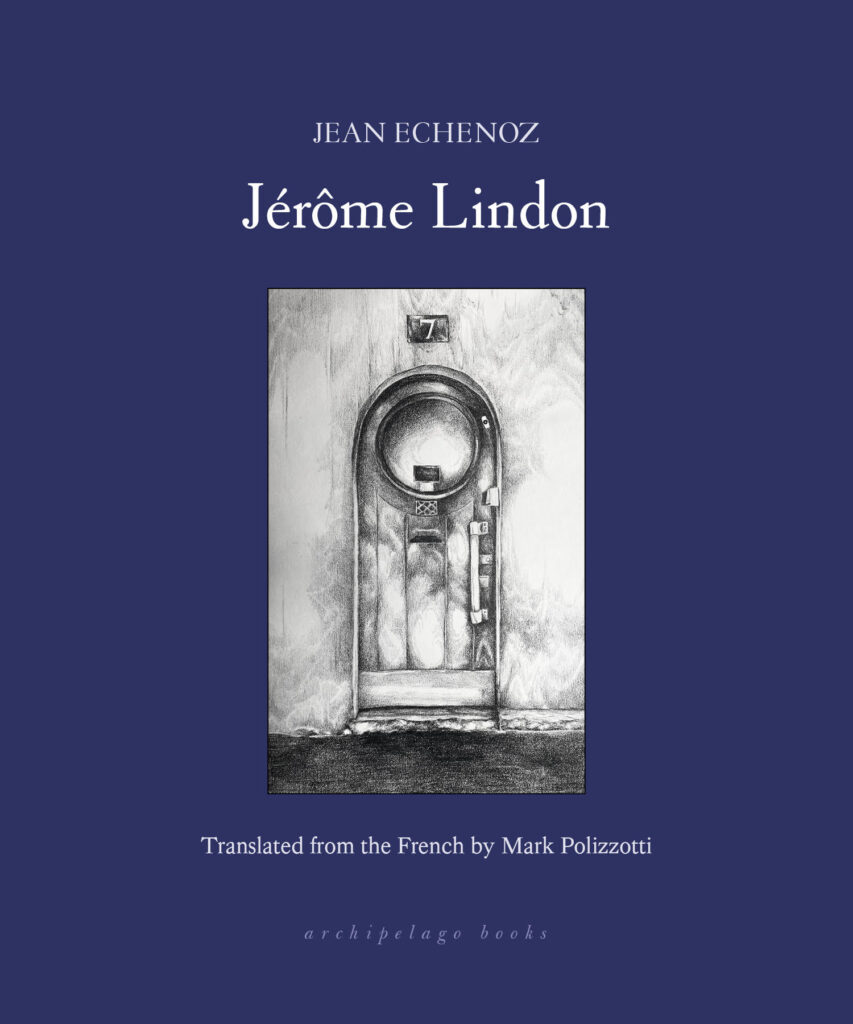
Jérôme Lindon by Jean Echenoz
Consider the fantasy of the author-editor relationship.
“As a young man, I imagined that an editor would be the author’s helpmeet, suffer with him through his torments, stroll by his side around the Luxembourg Gardens earnestly discussing where to introduce a character, the transition between two chapters, that sort of thing,” writes Jean Echenoz in Jérôme Lindon, his short and absorbing book about his longtime editor.
“I quickly realize from Jérôme Lindon that an editor has other things to do, or at least, he does. He has no patience for hand-wringing, and despises it when someone takes him for what he’s not, whether surrogate father, confessor, or therapist.”
The image that Echenoz does allow to enter this narrative about the storied editor of Parisian publishing house Les Éditions de minuit, which he wrote in the months following his death in April 2001, is that of a lion. How to do justice to such a legacy?
By the time we meet Lindon through Echenoz, he is already an intimidating figure, already immortalized for his championiLesng of Samuel Beckett, a moment in his career he does not shy away from narrativizing. Lindon’s first reading of Molloy in 1951 “made him laugh so hard he nearly dropped the unbound manuscript and sent it scattering all over La Motte-Picquet-Grenelle metro station,” Echenoz writes, “—that story I’ll hear often, we’ll all hear it often.” In Echenoz’s prose, Lindon oscillates with ease to his dual role as a man of flesh and blood and as a figure of literary history.
Lindon comes across as restrained, a quality which only heightens his moments of editorial or emotional intervention. The two men battle on the subject of commas, which Echenoz calls “only fundamental aesthetic divergence,” and we learn about the activities Lindon discourages from his writers (publishing in magazines, participating in symposia, writing for television, traveling).
Readers will find in this book a primer on the generation(s) of writers—names such as Jean Philippe Toussaint, Tony Duvert, Alain Robbe Grillet, Claude Simon, Robert Pinget, Marguerite Duras—who shared Jérôme Lindon as a publisher. His willingness to champion quality and originality remained steadfast. More than 30 years after his first encounter with Beckett, he features in the publishing origin story of Marie Ndiaye, whose first novel, Quant au Riche Avenir, Lindon published when she was still in high school. Beckett would later write of his editor: “I owe him everything. But should I have owed him nothing, or rather nothing beyond what we all owe him, I would still be saying, before such purity, such nobility of character, such courage, he is a great publisher and a great man.”
Jérôme Lindon’s compact 60 pages, translated by Mark Polizzotti with an attention to language which does great justice to its subject matter, can be read in a morning’s commute. It is perhaps best read this way, in the margins of a workday, as an unusually affirming account of the value of a life’s work.
Jérôme Lindon by Jean Echenoz (translated by Mark Polizzotti), Archipelago Books.
Click here to purchase this book with us.