Twenty Minutes of Silence by Hélène Bessette
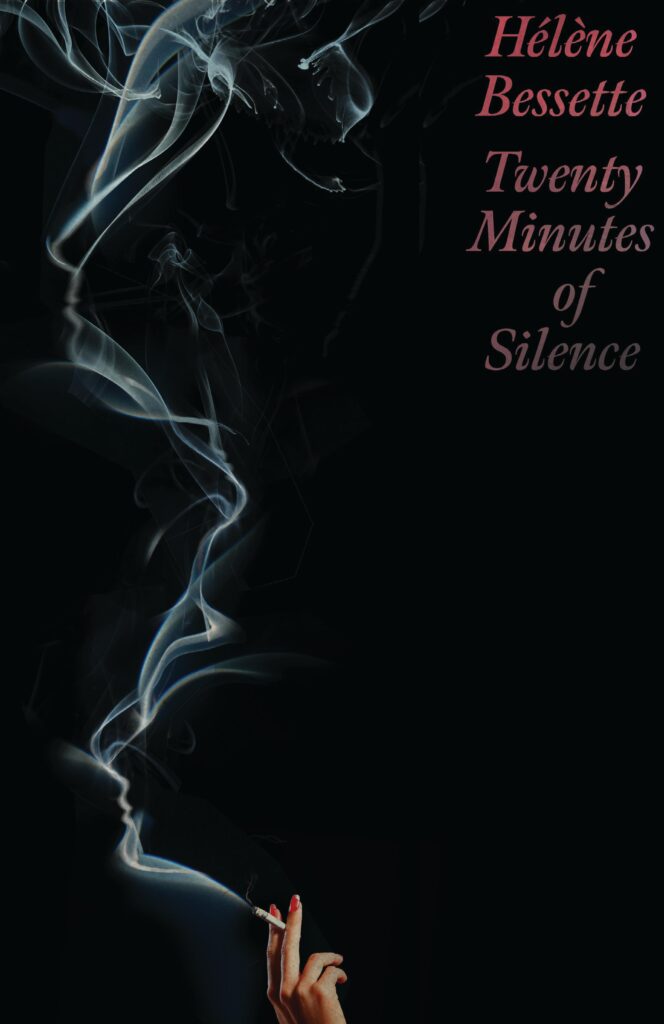
There are certain novels that demand to be read aloud. As I made my way through Hélène Bessette’s Twenty Minutes of Silence with its choral structure and litany of criminal accusations, I couldn’t help but think it should be read shouting.
This true crime-inspired murder-mystery novel, is, in typical Bessette fashion, not really a novel, a mystery, or a true account of the crime by which it was inspired. The elements of the story are introduced early and toyed with like pieces on a board of Cluedo (the family’s favorite game). We know the setting: “Villa Monique”, their bourgeois estate by the English channel, and the crime: a son shoots his father dead with a revolver in the middle of the night. We know that the mother was home too, and that it took 20 minutes for a doctor to arrive and declare the father officially dead. What we don’t know—and can’t know— are the characters’ motives.
“The mother is a real character.
The son is a real character,
The father is a real character
getting himself killed by his own son.
They’re a whole family of real characters,
But since all three are characters let’s not pursue that line of inquiry any further. Such considerations tell us nothing.”
It is fair to describe Bessette’s writing as challenging, but it would be wrong to not mention how delightful it is to meet this challenge as callbacks beget callbacks and repeated expressions create a hypnotizing effect. Kate Briggs’ translation preserves Bessette’s oddities (“A high grade girl aide, Rose, Rose-Pink Hollyhock.”) and her playfulness (“He had too much money. I don’t like money (I’m rich so I don’t have to like it).)”. The book is a thrill—a game where death should be.
Bessette’s mid-20th century experimental novels, published at Gallimard under her editor and champion Raymond Queneau (who memorably said of his mentee’s work “AT LAST, SOMETHING NEW!”) did not make her much money but they did earn her admiration from contemporaries like Iris Murdoch and Marguerite Duras and cult status for a small, devoted cohort of readers who carried her reputation into the new century.
Her manifesto on the Poetic Novel, published in issue one of Le résumé, a short-lived review founded in 1969 translated by Kate Briggs for The Yale Review, provides a useful lens through which to read her writing: “‘Poetic’ language is necessarily the language of difficult times. It is the language of suffering and the everyday normal expression in Times of war. In a noisy anxious world, it is the sentence that makes itself heard. A sentence that has no choice but to be haunting and painful. The cousin of Jazz. That grabs at the attention. It might be cruel. Evidence that it’s in the right place.” As true then as it is now.
Twenty Minutes of Silence by Hélène Bessette (translated by Kate Briggs), New Directions.
Click here to purchase this book with us.